A Low-Key Evening Reset for a Change in the Day
A low-key evening reset makes the shift from work to evening clearer with one visible cue, a place for unfinished tasks, and a simple next action.
The common mistake with a low-key evening reset is treating it as another task to complete. That can make the handoff from work feel like unfinished work in softer clothes. A better reset marks where daytime obligations pause and makes the first evening action clear.
This is not a plan for making every night restful. It is a way to stop work, caregiving, study, or errands from drifting into the evening by default. One visible cue and one deliberate handoff can do that without requiring a perfect schedule.
What makes a useful work-to-evening cue?
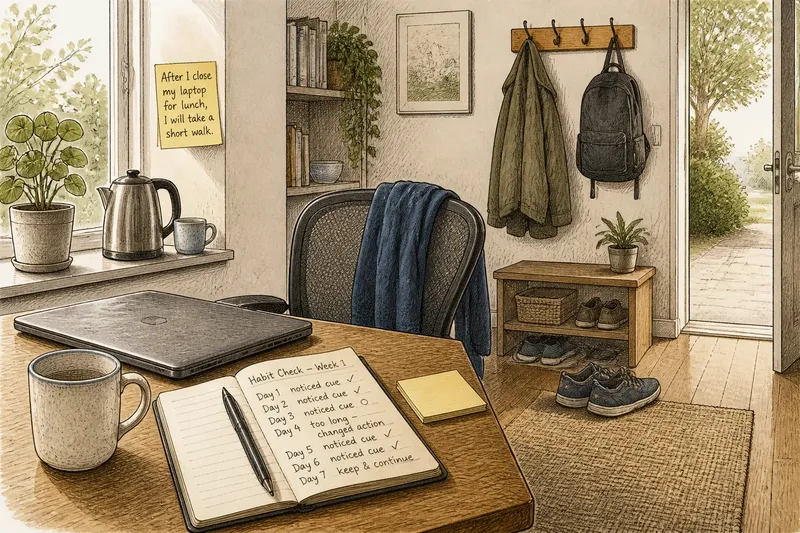
A useful cue is an action that visibly changes your relationship to the work in front of you. Close the laptop, put a work badge in its usual place, or move the notebook off the table. The action need not change your mood; it needs to show that you are pausing or switching tasks.
Choose a cue close to the actual end of your daytime obligations. If you work at home, closing a laptop and putting it in a drawer can separate it from the place where you eat. If you commute, hanging up your bag may mark the arrival home. For caregiving or shift work, the cue might be handing over a task to another person or washing your hands after a particular job.
Keep the cue possible on an untidy day. A ritual that depends on a clear desk, special music, and uninterrupted time is easy to lose when dinner runs late. Think of the cue as a door latch: a small physical action that makes the change legible, not a renovation of the whole house.
How do you park unfinished work?
Some work cannot simply be declared finished at the end of the day. Rather than trying to forget it, leave yourself a clear handoff. Write the next action on a sticky note, close the relevant document, and put the note where you will see it when you return.
Make the note concrete. “Continue project” leaves you to reconstruct the problem later. “Email Dana the revised agenda” gives the task a next move. If you cannot name a next action yet, write what needs clarification and who or what can provide it.
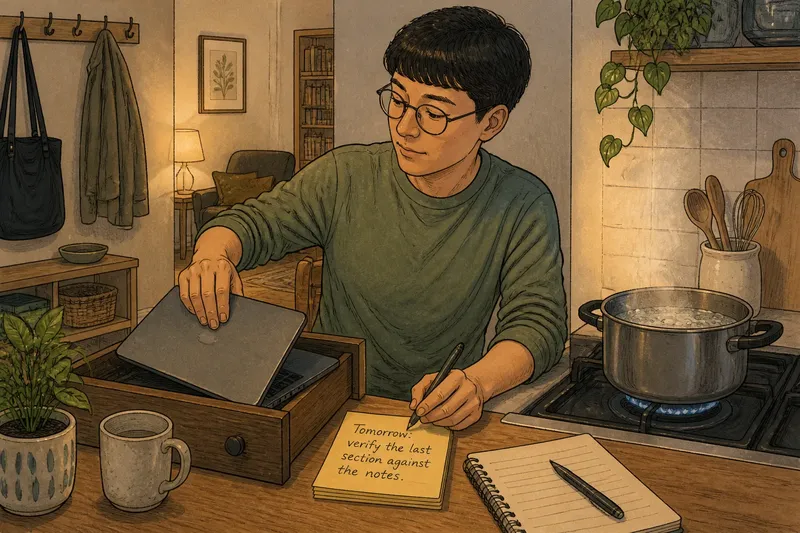
Say you are working at home and stop before sending a draft to a colleague. You close the laptop, then write, “Tomorrow: check the second paragraph against the meeting notes, then send the draft.” The result is a visible stopping point and a defined restart, rather than an open document that keeps inviting one more look during dinner.
A note does not solve an excessive workload or a workplace that expects constant availability. It only makes the immediate handoff clearer. If boundaries around work are repeatedly ignored, address that with a manager or another appropriate source of support where possible.
What should happen first after the cue?
Choose the next action based on what the transition requires, not on an ideal version of the evening. If you need food, start dinner. If you have to collect someone, gather your keys and leave. If you are free to choose, pick one activity with a clear first move, such as opening a book or putting walking shoes by the door.
Keep the choice specific enough to begin without further planning. “Make tea” gives you a first action; “have a better evening” does not. The point is to move from the last daytime task into the next real part of the night, not to add a second layer of performance.
Imagine an invented situation: Lee finishes a remote shift with a half-written report and dinner still to make. Lee writes “Tomorrow: verify the last section against the notes,” closes the laptop, and moves it off the kitchen table. Then Lee fills a pot with water and starts the pasta. The observable result is a recorded restart point, a work device out of the cooking space, and dinner underway; the tradeoff is that the report remains unfinished, rather than being disguised as a problem solved by a ritual.
What if work and evening overlap?
Not every day has a clean stopping point. A child may need attention, a bus may be due, or a work call may run into dinner. Mark a temporary pause honestly: put the work item aside while you eat, or write down when you expect to return to it. A boundary can be partial without pretending the obligation has vanished.
If another person needs your attention during the handoff, say what you can offer. “I need to change out of my work clothes, then I can listen” is clearer than hoping they infer it. If there is no pause available, name the constraint: “I can talk while I make tea, but I still need to finish this form afterward.”
For a recurring evening task, define the switch rather than insisting the workday is over. Put the bill to be paid in one folder, finish dinner, then return to the form if that is necessary. This keeps the sequence visible, even when work and home do not respect tidy borders.
Which evening reset questions come up most often?
How long should a low-key evening reset take?
There is no required duration. Closing a laptop and writing a restart note may take a moment, while cooking or commuting takes the time it takes; choose a cue that fits the actual handoff.
What if I forget to use the cue?
Use the next natural pause, such as putting away a work badge or sitting down after arriving home. You do not need to restart the evening or make up for missing the earlier moment.
Can a household chore be the first evening action?
Yes, if it is the next task that genuinely needs doing. Starting the dishwasher or preparing food can mark the shift from work to home without turning the chore into a test of how well you are relaxing.
What if I still need to work later?
Write down what remains and when you plan to return to it, if that timing is within your control. Then pause the task visibly; if work regularly spills into personal time without your consent, consider discussing expectations with a manager or another appropriate support.
How can you tell whether the handoff is working?
Look for practical signs tied to the transition. You might notice that the laptop is closed when dinner starts, that the next work action is written down, or that you leave for an errand without reopening a chat. If the cue is fussy, simplify it. If it does not help separate the tasks, choose a more visible action or change where you do it.
A low-key evening reset is useful when it gives the day a clear stopping point, even if that point is temporary. Keep the cue and handoff small enough to survive an ordinary, crowded evening; the rest of the night can remain ordinary too.