The Personal Letter as a Practice of Connection Across Distance
The personal letter made distance easier to bear through a shared ritual of writing, waiting, and replying, and its pages still offer clues to connection.
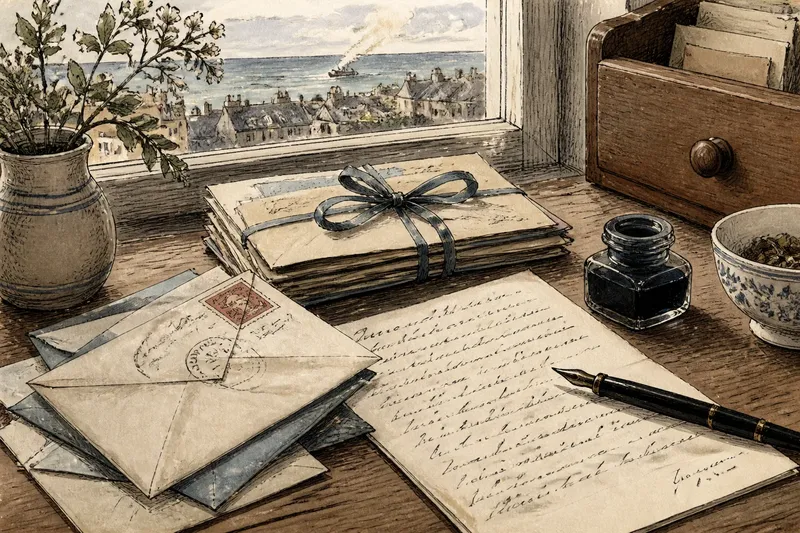
The common mistake in describing the personal letter is to treat it as a slower text message. That comparison misses the work the form required: a writer made time for a particular reader, put thoughts on paper, and sent them without controlling when they would arrive. The letter’s physical shape gave a relationship something to return to.
Say Mara, an invented young woman in the early twentieth century, leaves a coastal town for work in a city several days away by rail. Her brother Eli stays behind to help their family run a shop. They cannot visit often, so Mara writes on a Sunday and Eli replies when the mail reaches town. The letters do not erase the distance; they give the siblings a modest way to keep up with each other’s lives.
What made a personal letter more than a message?
A letter brought together several kinds of attention. The writer chose what to include, addressed a particular person, and arranged the page so the thoughts could be followed. The recipient encountered not only the words but also the handwriting, paper, and signs of the writer’s habits: a familiar slant, a cramped last line, or a correction left visible.
None of this made a letter automatically intimate. People wrote from affection, duty, business, and persuasion. A letter could be stiff or evasive, and a reply could arrive late or not at all. The form allowed for connection; it did not certify that connection was warm. Its particular quality was the shared object around which two people could direct their attention.
Mara might describe her lodging and ask whether the shop’s old stove still smokes. Eli can answer the question and mention what he does after closing. The page carries ordinary details alongside important news, much as a familiar bowl can hold supper without making a ceremony of it.
How did letter rituals support a relationship?
Correspondence involved a sequence of small actions. A writer found paper, chose a greeting, dated the page, folded it, sealed it, and sent it. The reader opened the envelope, read at their own pace, and decided what called for a reply. Like setting a place at a table, the object marked an intention to meet, though the people could not meet in person.
Ritual did not require grand declarations. A greeting could establish familiarity; a question could invite the recipient’s account; a closing could signal care without demanding a display of feeling. Conventional phrases gave writers a frame in which to say something particular. A frame is useful when the first sentence refuses to appear, as first sentences often do.
In Mara and Eli’s invented exchange, Mara keeps paper and envelopes together and chooses a regular evening to write. Eli leaves her letters in a drawer until he has a quiet moment to answer. The observable result is that each can refer to an earlier detail rather than starting the conversation afresh. If the routine becomes burdensome, either sibling can write less often or send a shorter note; the point is continuity, not obedience to a schedule.
What did waiting change?
Distance gave letters a rhythm shaped by travel, delivery, and the recipient’s availability. The writer sent a message without controlling when it would be read. That uncertainty could be difficult, especially when news was urgent. For ordinary correspondence, however, a delay also left room to compose a thought and for the reader to return to it.
A reply could address several points at once. Eli might remember Mara’s question about the stove while also describing the shop. She could see that he had taken care with the details, without either sibling having to announce what the exchange meant to them.
Delay does not improve every relationship. Silence can hurt, and urgent practical matters need a faster channel. A personal letter’s distinct contribution is the chance to write, send, reread, and answer as part of an unfolding correspondence. Its pace depends on the conditions of travel as well as on the writer.
How did the page itself carry meaning?
A letter’s parts helped organize the encounter. A date, salutation, paragraphs, signature, and postscript each had a role. A postscript might add a late thought; a brief note might suit a reader with little time. A full page or a short one can be read in many ways, so no single mark has a fixed emotional meaning.
Materials and access also shaped correspondence. Some writers had stationery; others used whatever paper was available. Ink, pencil, envelopes, postal routes, literacy, time, and a reliable address all affected who could write and how. The history of personal letters is therefore incomplete if it considers private feeling alone: the conditions for sending and receiving mattered too.
Imagine Mara receives a letter from Eli asking her to describe the view from her room. She looks out and notes the rooflines, market noise, and strip of sky between buildings. Her next letter offers a view selected for one reader, not a general report on the city. The observation becomes part of their exchange because Eli asked for it.
Why did people keep personal letters?
A letter could be read again after its arrival. The recipient could revisit a detail or return to the writer’s phrasing. A saved stack also made a relationship visible over time: envelopes accumulated, dates gave them an order, and the pages showed what someone had chosen to write down.
Letters were not all preserved. Paper could be lost, damaged, discarded, or withheld, and people differed in whether they had space or reason to keep it. Surviving correspondence is therefore partial. It records what one person wrote and another chose to retain, not the full texture of a conversation.
In the invented story, Mara saves a reply in which Eli describes the shop during a difficult season. Years later, the page may recall both the trouble and the fact that he wrote. It is not a complete record of their relationship, but it is a tangible part of it.
What do readers ask about personal letters?
When did personal letters become common?
There is no single starting point for personal correspondence. The ability to write and receive letters depended on conditions such as literacy, postal arrangements, access to paper, and social customs, which varied across places and periods.
Why did people use letters instead of visiting?
Work, family duties, distance, or the demands of travel could make a visit impractical. A letter let people exchange news without requiring them to be in the same place at the same time.
What made a personal letter different from a formal one?
The distinction depended on audience, purpose, and style rather than on one fixed format. Personal correspondence addressed a particular relationship; formal letters followed conventions suited to institutional or public business.
Why can old letters feel intimate?
They preserve choices of wording, detail, and address, along with traces of the physical act of writing. Their intimacy depends on what was included and saved, so a surviving page is a partial record, not an unfiltered conversation.
How can you read an old family letter with care?
Start with what the page actually contains, then separate observation from interpretation. These checks help prevent a familiar handwriting or affectionate greeting from carrying more certainty than the evidence supports:
- Check for a date; if it is present, use it to place the letter in sequence, and if it is missing, avoid assigning a precise date from style alone.
- Check the salutation and signature; if they name a person or relationship, note that wording, and if they are absent, do not assume who the intended reader was.
- Check for named places or events; if the letter supplies them, use those details to frame its context, and if it does not, mark the setting as uncertain.
- Check whether a passage is crossed out or hard to read; if the words are clear, transcribe them faithfully, and if they are not, mark the uncertainty rather than filling in a plausible phrase.
- Check for a postscript or direct question; if one appears, consider what response it invites, and if none appears, do not treat the letter as a request for an answer.
- Check the envelope or other accompanying pages; if they survive, compare their dates and names with the letter, and if they do not, avoid inferring a delivery history.
For instance, imagine an invented family letter with a date, a greeting to “Nell,” and a question about a garden. The reader records the date, notes the named recipient and question, and leaves the writer’s identity undecided because the signature is missing. The resulting account is narrower than a family story that confidently assigns the page to a particular relative, but it distinguishes what the page says from what remains unknown.
What does the personal letter offer across distance?
In Mara and Eli’s invented correspondence, connection comes from repeated acts of recognition. Mara asks about a familiar object; Eli answers and asks about her new surroundings; she describes what she sees for him. Their letters link two daily lives without pretending those lives are the same.
The personal letter offers a useful way to think about connection across distance: attention to particulars, repeated in a form another person can recognize. When reading old family papers, ask not only what news a letter reports, but what it invites its recipient to notice, remember, or answer. That question can reveal the relationship’s shape while leaving room for what the surviving page cannot tell you.